





A FORM OF LEARNING AND TRANSMISSION IN OUR MUSIC: MESHK
-

- 20 August 2025
A century-old musical tradition is being revived in the heart of the Little Hagia Sophia; both the venue and the melodies are coming back to life with meshk sessions
The Arabic word meshk, which is used in every field where the master-apprentice relationship is kept alive, especially in arts such as calligraphy and ebru, is used in the sense of training, practicing, and trying out. In a musical context, meshk refers to the process of reinforcing, correcting errors, and preserving the style of vocal and instrumental pieces through performance by hanendes (vocal artists) and sazendes (instrumentalists) when melodies are not written down in notation. Thanks to this teaching method, our great musical heritage has been carried to the present day and later put into writing with notation systems such as hamparsum.
So what is learned in these meshk sessions? First, music theory education, which we call nazariyat, is provided. The maqam systems that form the backbone of Ottoman/Turkish music are studied in depth, followed by the usul, which determine the rhythmic structure of our music. While hanendes are trained in style and approach, sazendes are trained in their respective instruments, with a focus on technique. And of course, most importantly, students listen to and perform the pieces repeatedly, committing the repertoire to memory. In this way, the memory of our music is passed down from generation to generation.
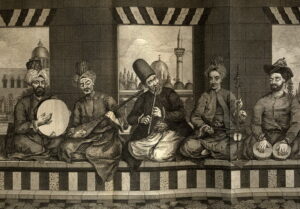
With the transition to a notation system in the late 19th and early 20th centuries, these forms of tasavvuf, fasıl, şarkı, nefes, and ayin were put into writing by musicologists, composers, and educators such as Rauf Yekta Bey, Suphi Ezgi, and Sadettin Arel. Of course, this situation led to significant criticism, as the desired emotion could not be fully conveyed through written notation, and music is essentially a matter of memory. Leading musicians of the period, such as Tanburi Cemil Bey, stated that Ottoman/Turkish music was so unique and based on the tradition of meshk that it could not be learned and performed using only the Western notation system. Ultimately, our music has survived to this day thanks to both the permanence provided by notation and the transmission of elements not indicated in the notation through meshk training.
Although it differs slightly from its traditional form, the practice of meshk continues to exist today in some tekkes, mevlevihanes, and among circles of music enthusiasts.
MESHK’S OF THE LITTLE HAGIA SOPHIA
One of the rare places where this tradition is kept alive is the garden of the Little Hagia Sophia Mosque, also known as the Kapıağası Hüseyin Ağa Madrasa… Built as an old Byzantine church in the 16th century, this structure was converted into a mosque during the reign of Bayezid II; over time, it gained a distinct identity with its zawiyas (religious lodges) surrounding the courtyard on three sides. Serving as a notable educational center during the Ottoman period and educating important figures such as Aziz Mahmud Hudâyî, this place now hosts workshops where traditional Turkish handicrafts such as calligraphy, tile, illumination, and mother-of-pearl inlay are kept alive.
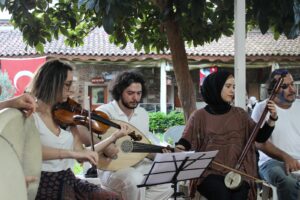
Every other Tuesday evening, in the heart of this historical fabric, the space comes alive once more through the musical gatherings I participate in with friends who share a passion for music. From the divine echoes of the ney to the tones of the oud and lavta that resonate within our inner worlds; from the deep mystical atmosphere of the rebab to the soothing sounds of the tanbur, many instruments come to life in this spiritual atmosphere, accompanied by sazendes and hanendes. Thus, the meanings that the space adds to people and that people add to the space intertwine to create a powerful harmony. Of course, I cannot fail to mention that these musical gatherings have been held in this pleasant space for many years, at various intervals, by important musicians.
Our repertoire, prepared by a specific authority and consisting of two parts, begins with taksims (improvisations) and lasts for approximately two hours. This open-to-all community welcomes both listeners and new musicians with ease. Although we form the core group of this ensemble, we take great joy in seeing it grow into a thriving musical family with the participation of new musicians and friends each day.
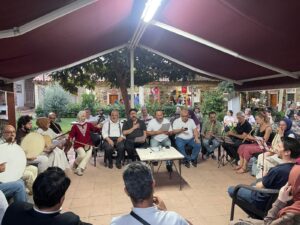
The story of our meshk sessions at Little Hagia Sophia is both sweet and quite long… If you’re curious about how this meshk came to be, where it has been performed over time, and how this meshk system works, we invite you to join us in the next issue of our magazine.